Starting a business in India is an exciting journey — but before you dive into operations, registering your company is the first and most essential step. It gives your business a legal identity, establishes credibility, and ensures compliance with Indian law.
From choosing the right type of entity to navigating regulatory procedures, each step in the registration process determines how strong your business foundation will be. Let’s explore how to register a company in India and understand the various options available.
Types of Company Structures in India
1. Private Limited Company
The most popular business form in India, a Private Limited Company (PLC) is governed by the Companies Act, 2013. It provides limited liability protection to its shareholders and offers greater flexibility for raising funds. PLCs are ideal for startups and growth-driven businesses.
2. Limited Liability Partnership (LLP)
An LLP blends the flexibility of a partnership with the limited liability benefits of a corporation. Governed by the Limited Liability Partnership Act, 2008, it is best suited for professionals and service-based firms seeking operational ease and lower compliance costs.
3. One Person Company (OPC)
Introduced under the Companies Act, 2013, an OPC allows a single entrepreneur to enjoy corporate benefits while retaining full control. It’s perfect for solo founders who wish to separate personal and business liabilities.
4. Public Limited Company
A Public Limited Company is suitable for large-scale enterprises planning to raise capital from the public. It offers shares to investors and operates under stringent regulatory supervision, making it ideal for corporations with expansive growth goals.
5. Sole Proprietorship
The simplest business form where a single individual owns and manages the enterprise. While easy to start, it offers no limited liability protection. Best suited for freelancers, small traders, or local service providers.
6. Partnership Firm
Governed by the Indian Partnership Act, 1932, a Partnership Firm involves two or more people sharing responsibilities, profits, and liabilities. This form is common for small and professional businesses operating on mutual trust and agreements.
7. Section 8 Company
A Section 8 Company is a non-profit organisation (NPO) registered under the Companies Act. It is dedicated to charitable, educational, or social causes and enjoys certain tax exemptions.
Need help in Company Incorporation ? See moreHow to Choose the Right Business Structure
Choosing your company type depends on several factors such as your business model, investment goals, liability preferences, and growth plans.
| Factor | Considerations |
|---|---|
| Nature of Business | Service-based, manufacturing, or consultancy? |
| Ownership & Investment | Do you need external investors or prefer full control? |
| Liability Protection | How much personal risk are you willing to bear? |
| Scalability | Will you expand or go public later? |
| Compliance Needs | What level of legal maintenance can your business manage? |
For example:
Freelancers → Sole Proprietorship / OPC
Startups → Private Limited Company
Professionals → LLP / Partnership
NGOs → Section 8 Company
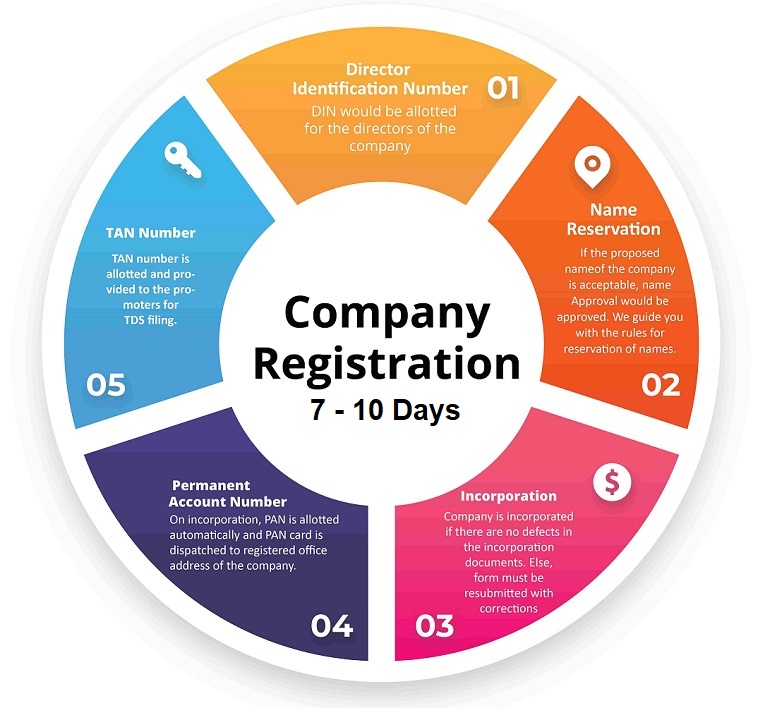
Step-by-Step: Company Registration Process in India
The company incorporation process in India is now entirely online through the Ministry of Corporate Affairs (MCA) portal. The key steps include:
1. Apply for Digital Signature Certificate (DSC)
Directors must obtain DSCs to authenticate documents electronically during the registration process.
2. Get Company Name Approval
Choose a unique company name following MCA guidelines. You can check availability on the MCA portal or through LawBRO’s name search tool to avoid duplication.
3. File Incorporation Application
Submit incorporation details including the company’s address, directors, and shareholders.
Private Limited / OPC: File via SPICe+ Form
LLP: File via FiLLiP Form
4. Receive the Certificate of Incorporation (COI)
Once approved, the MCA issues a Certificate of Incorporation, officially recognising your business as a legal entity.
Recommended Capital for Registration
| Type of Business | Minimum Paid-up Capital | Minimum Authorised Capital |
|---|---|---|
| Private Limited | ₹2 (min 2 shares) | ₹1 lakh |
| LLP | ₹10,000 | ₹10,000 |
| OPC | ₹1 (min 1 share) | ₹1 lakh |
| Public Limited | ₹5 lakh | ₹5 lakh |
| Sole Proprietorship | None | None |
| Partnership | None | None |
These values may vary depending on the business’s financial structure and compliance requirements.
After successful registration, businesses must maintain compliance with the Companies Act, 2013 and related laws. Key requirements include:
Annual General Meetings (AGMs)
Filing of Annual Returns with Registrar of Companies (RoC)
Preparation of Financial Statements
Maintenance of Statutory Registers
Board Meetings and Resolutions
Audit of Financial Accounts
Adhering to these ensures legal protection, investor confidence, and long-term sustainability.
Why Register with LawBRO?
At LawBRO, we make the entire company registration process simple, affordable, and transparent. Whether you’re launching your first startup or expanding your professional firm, we ensure your business meets all statutory obligations with minimal hassle.
What’s Included in LawBRO’s Incorporation Package?
Company Name Registration
Digital Signature Certificates (2)
Director Identification Numbers (2)
Certificate of Incorporation
Memorandum & Articles of Association (for Pvt Ltd/OPC)
LLP Agreement (for LLPs)
Company PAN & TAN
💸 All this starting at just ₹1,999 + Govt. Fees.
Let LawBRO handle the legal complexities while you focus on building your business.